

LAS MENINAS DIEGO VELASQUEZ
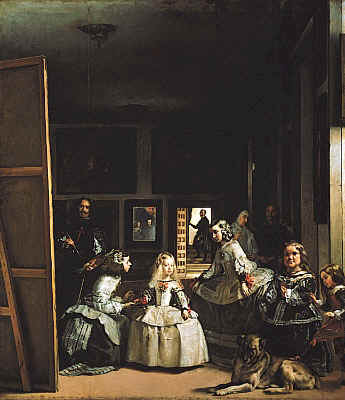
Las Meninas is a 1656 painting by Diego Velázquez (1599–1660), the leading artist of the Spanish Golden Age, in the Museo del Prado in Madrid. The work’s complex and enigmatic composition raises questions about reality and illusion, and creates an uncertain relationship between the viewer and the figures depicted. Because of these complexities, Las Meninas has been one of the most widely analysed works in Western painting.
Las Meninas” is self-aware in the sense that:
1. The painter paints himself;
2. The paints his own act of painting.
3. The object of the represented painter’s gaze (the subject of his painting) is the invisible authority that makes his painting possible, indeed, that authorizes all activity, including representation, in Spain: the king and queen of Spain who can be seen in the mirror behind the painter.
B. The self-awareness in “Las Meninas” reinforces the code of signs that grounds representation in 17th C. Spain. It does not put this code of representation into question.
C. More rigorously, however, one must say that the painting in fact constructs the fiction of a hidden king who stands behind all representations and authorizes them.
This is one the most celebrated group paintings in baroque art. The subject of the painting seems to be Princess Marguarita at the first glance. But a second look gives rise to tremendous curiosity. The mirror plays the role of a perfect motif to harbour such inquisitiveness. In the uncanniest manner, the focus of the painting shifts, perhaps even to the viewer!
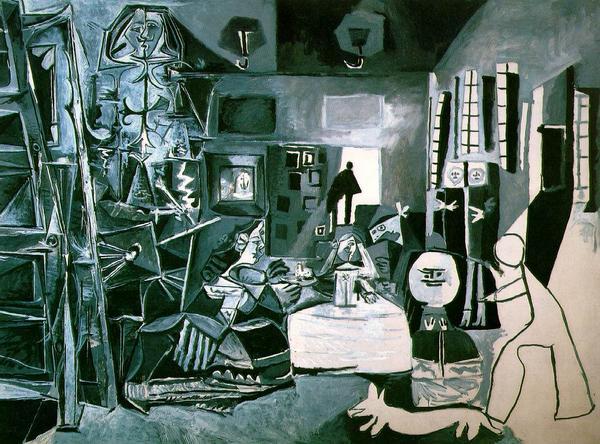
PICASSO VERSION